We design operating models built for growth in the AI era.

Teams are shipping more than ever. Where growth doesn't follow, the constraint is usually the operating model above the team, not the team itself.

Eranovus works in three stages: diagnose where the model is under strain, design the mechanisms that fix it, and implement them so your leadership team ends up running a redesigned operating model, not reading about one.

Step 01

Diagnosis

Growth problems root in different places — product-market fit, AI reshaping a market faster than the product or go-to-market can adapt, capability gaps inside a function or, where Eranovus works, the leadership operating model. We locate the constraint before prescribing anything. We are not a hammer looking for a nail. Where coordination is the issue, we distinguish structural failures — absent decision rights, priorities that aren't held — from behavioural ones. Each needs a different response.

Step 02

Design

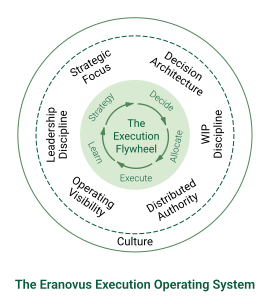
Design translates the diagnosis into a working operating model — a structured framework of proven components, levers and mechanisms: decision architecture, operating cadence, prioritisation discipline, execution visibility. We apply it according to what the diagnosis found binding — fixing the components under most strain first, and naming where to focus next as the business scales further.

The Eranovus operating model framework — seven components around the execution flywheel

The Eranovus operating model framework — seven components around the execution flywheel.

Step 03

Implementation

Implementation turns the design into mechanisms your leadership team runs on Monday — not a document that becomes someone else's project. Where it's useful, Eranovus stays engaged while they bed in, and beyond that, as a light-touch steward as the company scales further and the model needs to evolve again.

Where to start

Entry

AI-Era Execution Briefing

A half-day facilitated workshop that teaches the seven-component operating model framework and maps your business against it live. Your leadership team leaves with shared language on where execution is breaking and a written memo with the top hypotheses on where to focus. The lowest-commitment way to see whether the frame fits.

Diagnose

Execution Health Check

A comprehensive constraints diagnostic of your leadership operating model. Structured interviews across leadership, product, engineering and GTM. Board-grade assessment of where the operating model is about to fail, with commercial stakes tied to the KPIs you and the board already track. A prioritised plan you can act on whether or not you engage us for the redesign.

Design

Execution OS Design

Redesigning how the leadership team decides, prioritises, coordinates and tracks execution — lever by lever. The output is a working operating model the exec team runs with on Monday, not a strategy document. Covers decision architecture, operating cadence, WIP discipline and execution visibility. Scoped to the components that matter most, or across the full model.

Frequently asked questions

Is this about adopting AI tools?

No. Eranovus doesn't run AI tool rollouts, prompt-engineering workshops or vendor selection — Copilot, Cursor, an internal LLM workflow — that's a different discipline, working at the tool-adoption layer. The work sits one level up: the leadership operating model that has to absorb whatever your teams produce, regardless of which tools generated it. If your team is already shipping more because of AI, the question is whether the leadership layer above that output can keep pace — not which tools got you there.

Is this the same as EOS® / Traction® (the Entrepreneurial Operating System)?

No — different discipline, similar-sounding name. EOS/Traction is a franchised methodology for small-to-mid-size businesses, with its own toolkit and certified implementers. Eranovus diagnoses and redesigns a scaling software company's leadership operating model for AI-era execution pressure — decision architecture, prioritisation, coordination, visibility. If you already run EOS/Traction, the two are complementary, not competing — this sits alongside whichever meeting system you use, not in place of it.

How is this different from hiring a COO or Chief of Staff?

It doesn't replace either role — it changes when and why the hire succeeds. Most founders respond to coordination breakdown by hiring a CoS or COO to bridge the gap with their own bandwidth. The hire is rarely wrong; the timing usually is. Hiring someone to fix an undesigned operating model fails predictably — the mechanisms that would let them succeed don't exist yet. Hiring someone to operate a designed model succeeds, because the mechanisms are already there to run. Eranovus redesigns the model first, which is what makes the next CoS or COO hire work.

How is this different from management consulting?

Eranovus works shoulder to shoulder with your exec team on the live operating model and leaves with mechanisms the team runs on Monday — not a deck that becomes someone else's implementation problem. It's also narrower in scope than most consultancies: leadership operating model design, specifically. No finance work, no org design, no M&A support, no go-to-market strategy.

What if the problem isn't the operating model — we're struggling with product-market fit, or AI is disrupting our market?

That's part of what the diagnosis is for, not something you need to work out yourself first. AI disruption sometimes shows up as a coordination problem, sometimes as an eroding product-market fit, sometimes as both — we identify which one you're facing rather than assuming it. And where fit is genuinely the issue, the operating model still matters: it's what lets your leadership team execute cleanly on the fix, instead of the fix getting lost in the same coordination strain that's slowing everything else down.
See where you stand